Special Issue on Case Reports & Clinical Vignettes
Medical Technologies Journal (MTJ) maintains rigorous standards of peer review to ensure the accuracy, scientific integrity, and international quality of published research. MTJ operates a Double-Blind Peer Review process, where the identities of both authors and reviewers are kept confidential throughout the evaluation workflow.
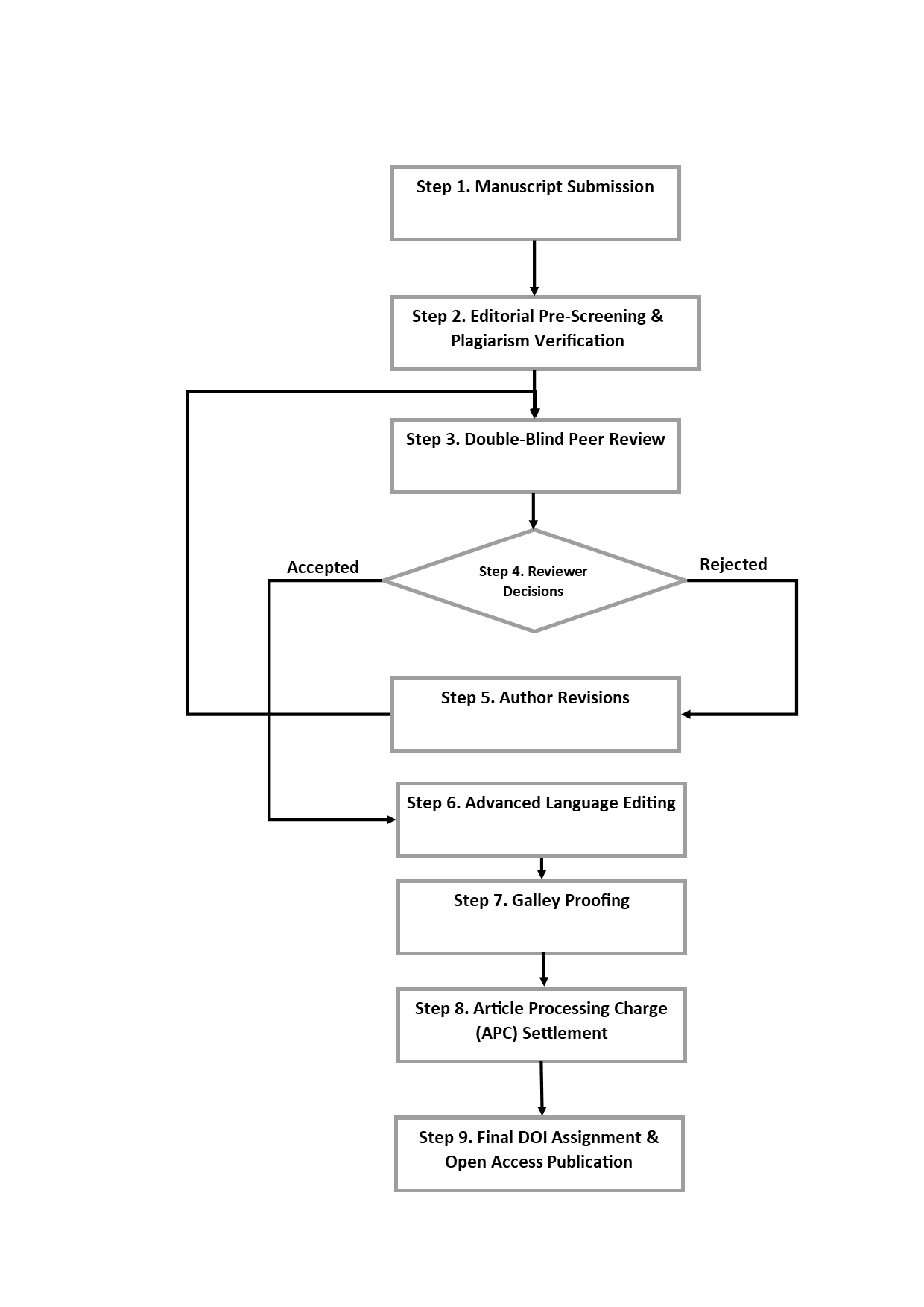
Comprehensive Editorial Workflow
Step 1. Manuscript Submission
Authors submit manuscripts via the MTJ online submission system. Submissions must include:
Step 2. Editorial Pre-Screening & Plagiarism Verification
Upon submission, the Editorial Office conducts an initial quality control check within 1–3 business days:
Step 3. Double-Blind Peer Review
Manuscripts passing pre-screening are assigned to an Associate Editor and invited expert reviewers:
Step 4. Reviewer Decisions
Reviewers provide comprehensive feedback and assign one of five evaluation categories:
Step 5. Author Revisions & Re-evaluation
Authors receive the reviewers' reports and detailed decision letter. Revised manuscripts must be submitted alongside a Point-by-Point Response Table addressing all reviewer comments. Final acceptance requires approval from all assigned reviewers and the Editor-in-Chief.
Step 6. Advanced Language Editing & Copyediting
Accepted manuscripts undergo native English copyediting and technical polish. Authors receive final language comments to ensure international readability and publication-grade terminology.
Step 7. Galley Proofing & Formatting
The production team formats the manuscript into MTJ's official publication layout. The corresponding author receives a PDF galley proof for final review and sign-off within 48 hours.
Step 8. Article Processing Charge (APC) Settlement
Following proof approval, the corresponding author receives payment instructions for the Article Processing Charge (APC). The APC covers open-access publishing, similarity checks, DOI registration, layout design, and digital preservation taxes under Knowledge Kingdom Publishing.
Step 9. Final DOI Assignment & Open Access Publication
Upon confirmation of APC settlement, a persistent Digital Object Identifier (DOI) is assigned, and the final version of record is immediately published open-access.
Editorial Review Flowchart
Below is the visual overview of the editorial workflow from initial submission to open access publication:
11th International Conference on Health Sciences and Medical Technologies
Medical Technologies Journal is an online international refereed journal published from 2017. It aims to publish an interdisciplinary research findings and innovations in medicine, sciences and technologies. The journal is available for open access.
ISSN: 2572-004X
URL : medtech.ICHSMT.org
DOI: https://doi.org/10.26415/2572-004X
Email: medtechjournal@gmail.com
KNOWLEDGE KINGDOM PUBLISHING ©2017-2020
